


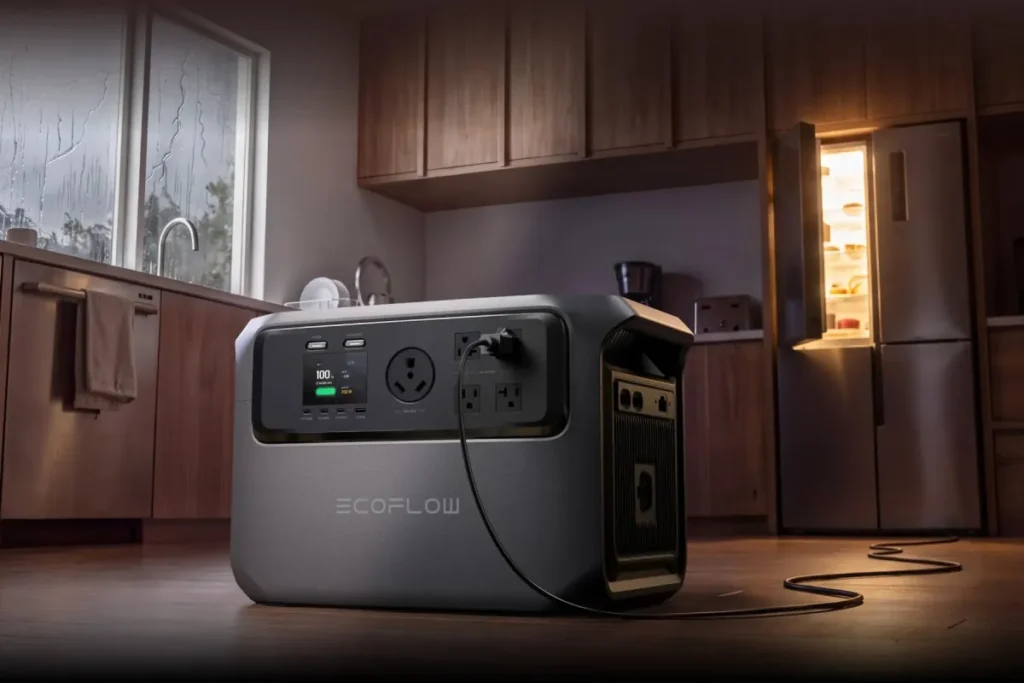
Camping trips, remote job sites, and balcony setups without a stable grid connection all share one problem: keeping devices and appliances running. Portable power stations have become the practical answer, storing electricity that can be drawn on wherever an outlet is not available. EcoFlow builds several distinct product lines aimed at exactly this gap, from compact units for weekend trips to larger systems meant for extended off-grid stretches.
Understanding Portable Power Stations and Their Core Function
At their simplest, portable power stations are rechargeable battery units that store electricity and release it through standard outlets, USB ports, or car sockets. They replace the need for a fixed electrical connection, which matters for campers, outdoor workers, and anyone facing a power outage. Unlike a generator, they run silently and produce no exhaust, which is why they show up so often in camping, fishing, and outdoor DIY scenarios.
Capacity and output are the two numbers that define what a unit can actually do. Capacity, measured in watt-hours, determines how long a device can run before recharging is needed. Output, measured in watts, determines how demanding a connected device or appliance can be before the station struggles to keep up.
EcoFlow DELTA Series: High-Output Solutions for Demanding Applications
The DELTA 3 Classic from EcoFlow is built around a 1,024 Wh capacity with 1,800 W of continuous output and 3,600 W of peak output. Its X-Boost technology allows it to support higher-draw devices up to 2,400 W without cutting out. It also uses an LFP battery chemistry and reaches 80% charge in 45 minutes through AC charging, which suits scenarios like camping, fishing, or outdoor work where downtime between charges needs to stay short.
Moving further up the line, the DELTA 3 Max Plus reaches a 2,048 Wh capacity with 3,000 W of rated AC output and 6,000 W of peak output, and at that output level It rates it to run a microwave, kettle, refrigerator, and blender at the same time. Its X-Boost 3.0 mode extends support to devices drawing up to 3,900 W. EcoFlow also built in Smart Output Priority Tech, letting specific circuits be kept active through an app while others are powered down to stretch runtime.
EcoFlow RIVER Series: Lightweight and Fast-Charging Options for Mobile Use
Where the DELTA series leans into higher output, the RIVER series from EcoFlow is built for portability. The RIVER 2 carries a 256 Wh capacity and 300 W of output, paired with a charge time of 0 to 100% in just 60 minutes. That speed is notable since EcoFlow states it is 70% faster than the industry standard for comparable units.
Weight is another focus point for this line. The RIVER 2 weighs just 3.5 kg, which is described as 30% lighter than typical units in its class. For remote work or short camping stints where the station needs to be carried rather than left in a vehicle, that weight difference is a practical consideration rather than a marketing detail.
EcoFlow STREAM Balkonkraftwerk: Solar-Integrated Home and Balcony Energy Systems
The STREAM line shifts the focus from mobile use toward stationary solar storage, particularly for balcony setups. The STREAM 5000 from EcoFlow combines a 5,024 Wh capacity with a 5,000 W solar input and up to 3,000 W of AC output, which allows a balcony-mounted solar array to feed directly into stored capacity. The STREAM AC 5000 shares the same 5,024 Wh capacity and up to 3,000 W AC output while being built to work alongside solar arrays that are already installed.
This series positions The brand as a provider not just of portable units but of small-scale home energy storage tied to solar generation. For a balcony or home setup without full off-grid independence, pairing a battery like this with existing or new solar panels extends how much self-generated electricity can actually be used rather than lost.
Multi-Device Charging and Simultaneous Power Management
A power station is only as useful as the number of things it can run at once, and the combined load handling described for the DELTA 3 Max Plus above is what separates a dedicated power station from a simple backup battery pack. Concurrent appliance support matters more once camping or remote work stretches past a single afternoon. That is why output figures and simultaneous-device ratings tend to matter more than capacity alone when comparing stations.
Charging flexibility matters just as much as output once multiple devices are in the mix. EcoFlow‘s lineup spans several charging inputs depending on the model, and the combination of these methods is part of what makes the stations adaptable across camping, vehicle, and home scenarios.
- AC wall charging is available across the lineup, with the DELTA 3 Classic reaching 80% charge in 45 minutes.
- Solar panel input lets stations like the STREAM 5000 accept up to 5,000 W directly from connected panels.
- Vehicle charging through a car’s electrical system is supported on select DELTA models for charging while in transit.
- Multi-charging capability on the DELTA 3 Max allows several charging methods, including grid, solar, and alternator, to combine for faster overall charging.
Scaling Energy Capacity with Expandable Battery Systems
Several stations in the range are designed to grow beyond their base capacity through add-on batteries. The RIVER 3 Plus, for instance, can be extended up to 858 Wh using either an EB300 (286 Wh) or EB600 (572 Wh) additional battery, connected through a cable-free pogo-pin link. That kind of expansion means an initial purchase does not have to be the ceiling on how much stored energy is available later.
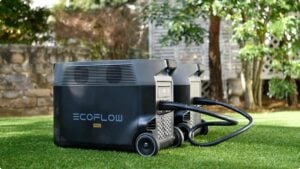
The DELTA 3 Max Plus follows a similar approach with its own expansion adapter, which connects two intelligent additional batteries using a single cable. This modularity is relevant for remote work setups or extended camping stays, where energy needs can shift from one trip to the next. Rather than purchasing an entirely new unit, capacity can be added incrementally to match the situation.
Across its DELTA, RIVER, and STREAM lines, EcoFlow covers a fairly wide range of scenarios, from a lightweight station for a weekend away to a solar-fed system for balcony-based home storage. Portable power stations in this range are ultimately judged on how well output and charging flexibility hold up together, not on capacity figures alone.
That balance between stored capacity, output, and charging speed is what keeps the category relevant well beyond a single camping season.